
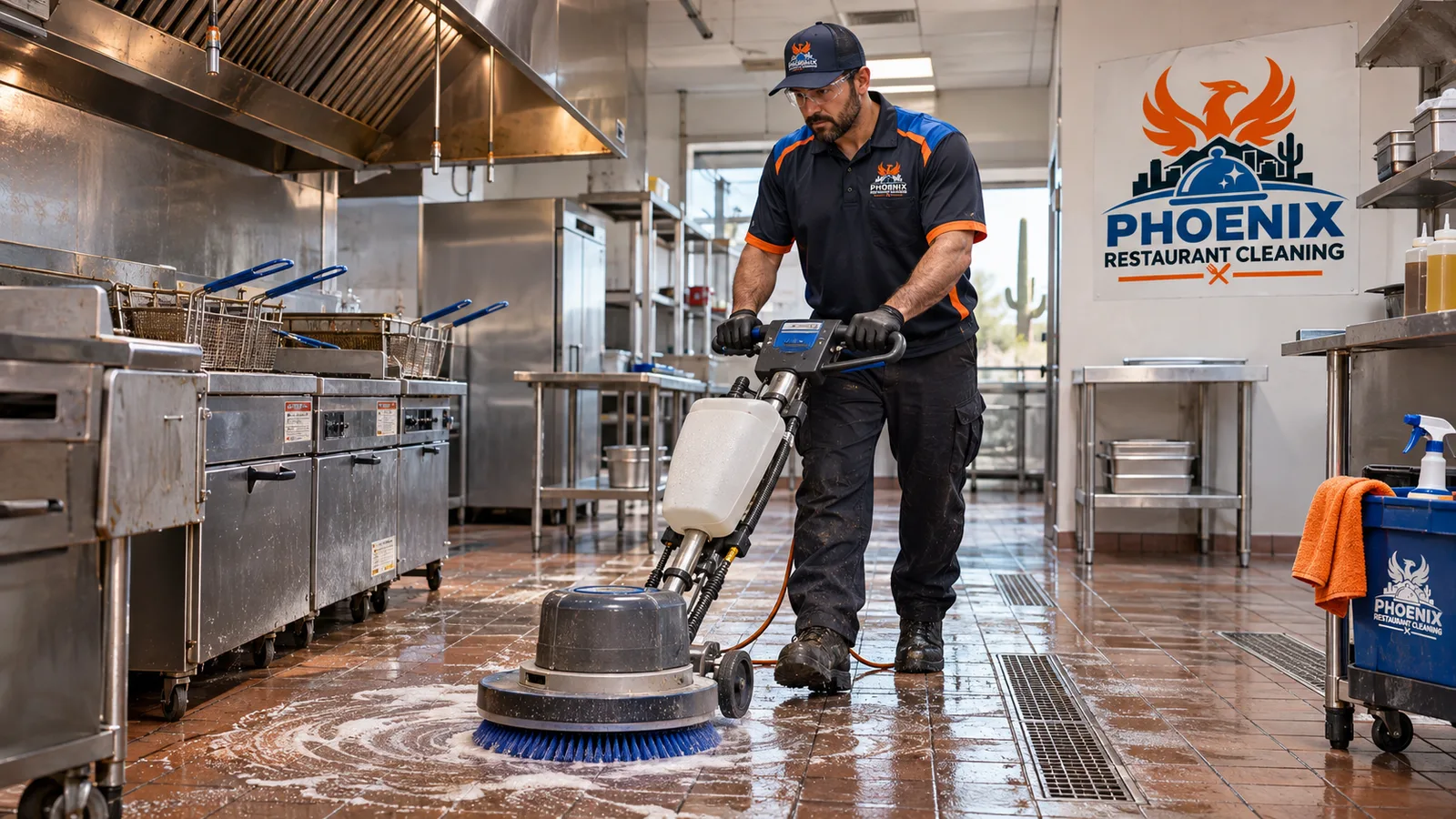
Technician using commercial floor-cleaning equipment on tile in an empty restaurant kitchen with fryers, prep tables, and floor drains visible
Floor Cleaning · Phoenix, Arizona

Commercial Kitchen Floor Cleaning

Remove stubborn grease, food residue, and soil from restaurant tile and grout with a cleaning plan built around your kitchen layout and operating schedule.

✓ Restaurant floor focus
✓ Tile and grout care
✓ Grease and soil recovery
✓ Scheduling around operations
Restaurant Floor Cleaning

Cleaner Floors Without Disrupting Service

Commercial Kitchen Floor Cleaning targets the greasy film and compacted soil that routine mopping often leaves behind. Cooking oil, tracked-in grit, food particles, and detergent residue collect in grout lines, along wall edges, beneath movable equipment, and around floor drains. When buildup remains, floors can look dull, feel slick, and become harder for staff to maintain.

Phoenix Restaurant Cleaning provides restaurant floor cleaning services for commercial kitchens in and around Phoenix. Our team assesses the flooring, soil level, traffic patterns, and access before selecting the cleaning method. On every job, a restaurant service company Phoenix homeowners rely on brings the same practical care to the work by protecting nearby surfaces, treating problem areas, recovering dirty solution, and leaving the area ready for the next stage of your operation.

Scheduling matters as much as cleaning technique. Downtown Phoenix kitchens may need work coordinated around event traffic and late closing times. Roosevelt Row restaurants often operate in compact spaces where equipment access must be planned carefully. In warehouse-style kitchens near Phoenix Sky Harbor International Airport, larger production areas may require the work to be divided into zones. We establish the scope before service so managers know which areas need to be cleared and how the work will proceed.

Tile and Grout Treatment

Restaurant Tile Cleaning and Grout Care
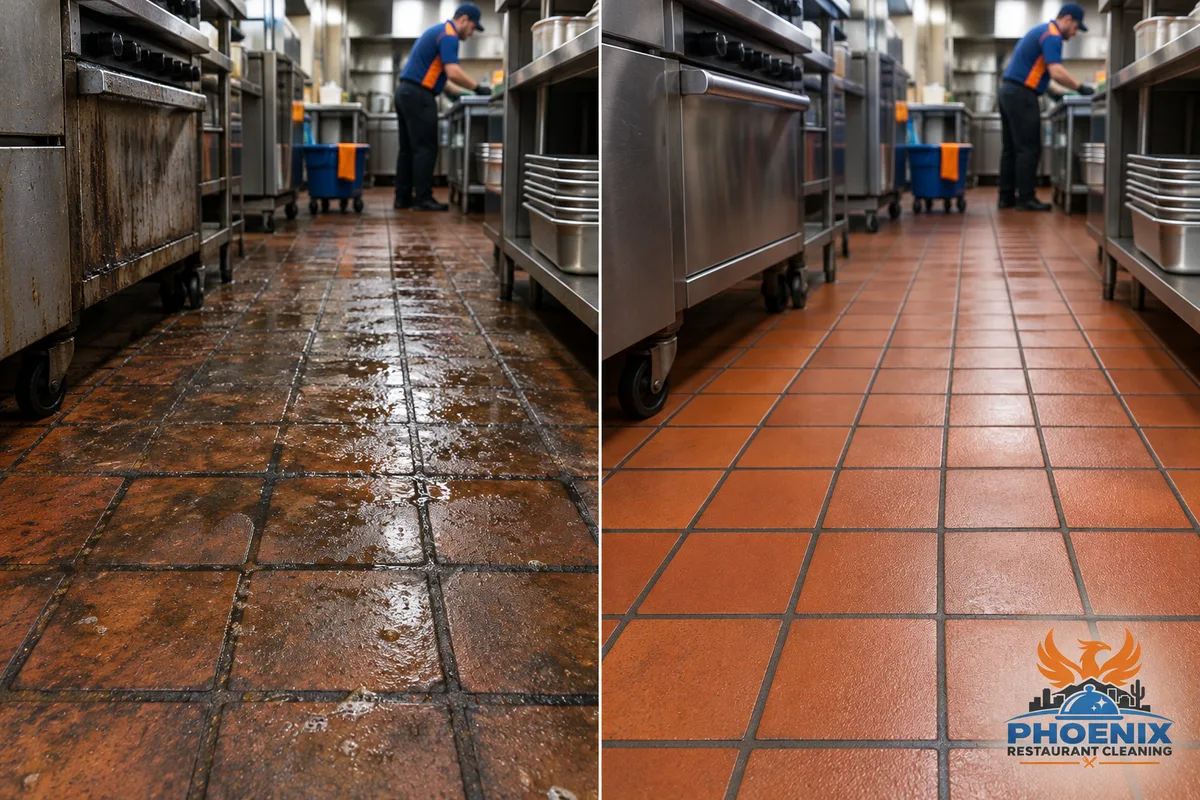
Side-by-side view of greasy restaurant quarry tile and dark grout before cleaning and the same area after professional degreasing and soil recovery
Detailed treatment reaches the recessed grout and edges that routine mopping can miss.

Ceramic and quarry tile are common kitchen floor materials because they tolerate heavy use, but their grout joints are porous and textured. Grease can bind with fine soil inside those joints, creating dark lines that ordinary mop water does not remove. Restaurant tile cleaning must address both the face of the tile and the recessed grout.

Treatment starts with a commercial degreaser selected for the surface and the type of buildup. After appropriate dwell time, agitation helps release soil around grout joints, equipment legs, coves, thresholds, and other hard-to-reach areas. Mechanical scrubbing may be used on open floor areas, while detailed hand agitation handles corners and edges. Dirty solution is then extracted or recovered rather than spread across the floor with a mop.

Restaurant grout cleaning can improve appearance, but discoloration is not always removable soil. Permanent staining, missing grout, failed joints, and damaged tile require repair rather than additional cleaning. We identify visible defects before work begins and set realistic expectations for heavily worn floors.
Request a Callback
Problem Areas

Where Grease and Buildup Collect

Cook Lines and Fryer Areas

Airborne oil and small spills settle around fryers, ranges, equipment feet, and wall edges. Kitchen floor degreasing breaks down this bonded film before agitation and recovery.

Prep and Dish Areas

Food residue, moisture, and frequent foot traffic can create stubborn soil around prep tables, sinks, dish machines, and floor drains.

Grout, Corners, and Cove Bases

Recessed joints and tight edges hold material that flat mop heads pass over. Detail work loosens buildup without treating every surface as if it were identical.

Walk-Ins and Storage Routes

Cart wheels and shoes carry soil between storage, refrigeration, and production areas. Cleaning these travel paths helps prevent immediate redistribution.

Entry and Transition Areas

Grit from parking areas and service alleys can abrade flooring and combine with grease near kitchen entrances. Phoenix's dry conditions make tracked dust a recurring maintenance issue.

Dining-Side Tile

When included in the agreed scope, compatible tile in server stations and other restaurant work zones can be cleaned during the same scheduled visit.

Request a Callback
How Service Works

Our Restaurant Floor Degreasing Process

  1. 01

    Inspect the Floor and Confirm the Scope

    We identify the flooring material, grease concentration, grout condition, drains, damaged areas, and equipment that can be moved safely. The plan also accounts for opening, closing, delivery, and food-preparation schedules.

  2. 02

    Prepare the Work Area

    Loose debris is removed, accessible items are relocated, and nearby surfaces are protected as needed. Staff should remove food, smallwares, floor mats, and lightweight movable items before the appointment unless another arrangement is made.

  3. 03

    Apply the Appropriate Cleaning Chemistry

    A compatible commercial cleaner or degreaser is applied at the proper dilution. It is given enough dwell time to work on oily soil without being allowed to dry on the floor.

  4. 04

    Agitate Tile, Grout, and Edges

    Mechanical scrubbing addresses open areas, while brushes reach grout joints, coves, corners, thresholds, and equipment perimeters. Technique is adjusted for the floor's texture and condition.

  5. 05

    Recover Soil and Rinse as Needed

    The released grease and dirty solution are collected from the floor. Rinsing or neutralizing is performed when required by the chemistry and surface, reducing the residue that can make a floor attract soil quickly.

  6. 06

    Review the Completed Areas

    We check the agreed work zones and point out remaining stains, failed grout, cracked tile, or other conditions that cleaning cannot correct. Drying and reopening guidance is based on the flooring and treatment used.

Request a Callback
Phoenix Service Conditions

Commercial Floor Cleaning for Phoenix Kitchens

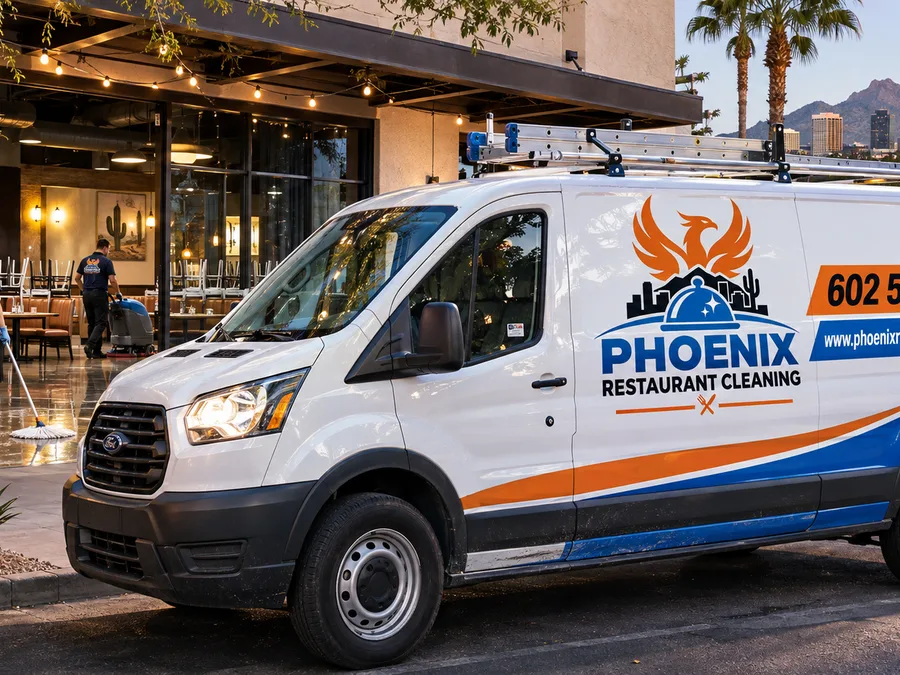
Commercial floor-cleaning equipment staged beside a Phoenix restaurant service entrance at dusk for after-hours kitchen cleaning

Phoenix restaurants contend with fine outdoor dust that enters through kitchen doors, loading areas, and staff entrances. That grit mixes with cooking oil and can form a dull, sticky layer. Frequent dry-soil removal and correct degreaser dilution help keep the mixture from being redistributed during routine mopping.

Local operations also vary widely. Downtown kitchens may have limited loading access and short service windows. Arcadia restaurants commonly include busy dining and patio traffic, which can carry outdoor soil through transition areas. Tempe's Mill Avenue district has late operating hours and concentrated foot traffic, so overnight scheduling may be the practical choice. Old Town Scottsdale restaurants often need kitchen work completed before daytime deliveries and guest service resume.

We tailor restaurant floor cleaning in Phoenix to the actual facility rather than applying one procedure to every floor. A compact cook line with deep grout needs a different plan than a large commissary kitchen with wide tile aisles. Surface type, drainage, equipment density, grease load, and available downtime all affect the method and crew plan.

Request a Callback
Ongoing Maintenance

A Practical Plan for Ongoing Floor Care

Deep cleaning works best as part of a realistic maintenance plan. Staff should remove loose food and debris before wet cleaning, use properly diluted products, change dirty mop solution, and keep separate tools for greasy kitchen zones. Overusing detergent can leave a film that attracts more soil. A mop that is already loaded with grease transfers residue instead of removing it.

Match Frequency to the Kitchen

Professional service frequency depends on cooking volume, floor texture, equipment arrangement, operating hours, and how well daily procedures control spills. A high-output fryer line may need more frequent restaurant floor degreasing than a low-grease prep kitchen. We can identify recurring trouble spots and help managers choose a schedule based on observed conditions rather than an arbitrary calendar.

Know What Cleaning Can Correct

Slip resistance depends on several factors, including contaminants, footwear, tile texture, drainage, and floor condition. Cleaning removes grease and soil, but it cannot repair worn texture, poor slope, damaged drains, or deteriorated grout. Spills still require prompt attention, and wet-floor controls should remain part of the restaurant's safety procedures.

Request a Callback
Phoenix Floor Cleaning Costs

How Much Does Commercial Kitchen Floor Cleaning Cost in Phoenix?

Commercial kitchen floor cleaning in Phoenix typically costs about $0.35 to $1.00 per square foot, while small or heavily soiled jobs may carry minimum service charges or higher effective rates. Light maintenance cleaning is usually less costly than intensive degreasing with detailed grout agitation.

Final pricing depends on floor area, grease load, tile texture, grout condition, equipment access, drainage, parking, scheduling, and the amount of hand detail required. Add-on areas such as walk-ins or server stations also change the scope. Exact cost is confirmed after an inspection or a review of the facility and work requirements.

Request a Callback

Get a clear cleaning scope built around your kitchen's flooring, grease conditions, access, and operating hours.

Frequently Asked Questions

Commercial Kitchen Floor Cleaning Questions

Can commercial kitchen floor cleaning be scheduled after closing?+

Yes, scheduling can often be arranged around closing, prep, delivery, and reopening requirements. After-hours work is especially useful for busy Downtown Phoenix and Mill Avenue kitchens where daytime access is limited. The required window depends on floor area, equipment density, soil level, and drying needs.

How often should a Phoenix restaurant schedule floor degreasing?+

The right interval depends on grease production, traffic, floor texture, and daily maintenance quality. Fryer-heavy cook lines may need professional degreasing more often than prep-focused kitchens. Phoenix dust can also combine with oily residue near service entrances, so those routes may need extra attention.

Do we need to move kitchen equipment before restaurant tile cleaning?+

Small movable items, mats, food, and loose supplies should generally be cleared before service. Heavy or connected equipment is cleaned around unless safe movement has been agreed upon in advance. Access requirements are confirmed during the scope review so staff can prepare without disrupting fixed utilities.

Will restaurant grout cleaning restore every grout line to one color?+

No, cleaning removes accessible soil but cannot guarantee uniform color where grout is permanently stained, repaired with mismatched material, worn away, or damaged. An inspection can distinguish likely buildup from defects that need regrouting or repair.

What types of commercial kitchen flooring can be cleaned?+

Many ceramic, quarry tile, concrete, and compatible resilient floors can be professionally cleaned, but the method must match the material and its condition. Acid-sensitive surfaces, coated floors, damaged joints, and unknown finishes require extra evaluation before chemicals or mechanical agitation are used.

How long does restaurant floor cleaning take?+

A small accessible kitchen may take a few hours, while a larger or heavily soiled facility may require a longer window or zoned service. Equipment layout, hand-detail work, drainage, rinsing, and drying all affect timing. The expected work window is established after the floor and operating schedule are reviewed.

Can kitchen floor degreasing make a worn floor slip-proof?+

No, degreasing removes oily contamination but cannot make any floor slip-proof. Tile texture, footwear, moisture, drainage, damaged surfaces, and new spills continue to affect traction. Prompt spill response and suitable wet-floor procedures remain necessary after cleaning.

Plan a Cleaner Kitchen Floor

Tell Phoenix Restaurant Cleaning about your floor material, problem areas, operating schedule, and access. We will help define the work and determine the right approach for your restaurant.